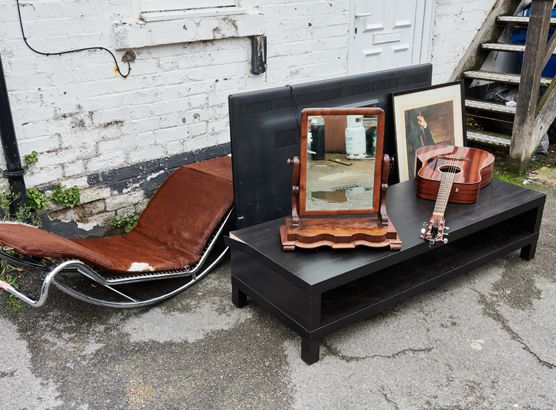
This article was written by Liam Melody, founder of Clear It Out (Environment Agency Waste Carrier Licence CBDU176999), a licensed house clearance company operating in London, Surrey and Kent. It covers why clearing items before a professional assesses a probate property often costs executors money, how the second-hand market has shifted in ways most families do not expect, what a formal probate valuation involves and when it is necessary, and what executors should do before a clearance begins.
The call I get most often, in the weeks after someone has passed, goes something like this: we have had a clear-out already and got rid of the obvious stuff. There is still quite a bit left but we think it is mostly junk. Could you come and take a look?
Sometimes that is right. But more often than I would like, the obvious stuff they have already cleared is exactly the kind of thing that would have offset a meaningful part of the clearance cost.
I am not saying this to criticise anyone. Probate is exhausting. You are dealing with grief, administration, timelines and usually other people’s expectations all at once. The impulse to do something productive, to make a start, to feel like you are moving things forward, makes complete sense. But clearing items before a professional has looked at them is one of the most common and costly mistakes made during estate clearances. And it happens because most people do not know how the model works.
In my experience, the properties that come to us completely untouched are usually those where a solicitor has been involved from the start and has given professional advice early. The families who have already cleared a significant portion of the property are, almost without exception, the ones who did not know to call first.

How the Cost-Offset Works
A house clearance is not simply a removal service. On any probate job, we go through the property carefully before quoting, because what is in that property directly affects what the job costs. Items that can be resold or donated reduce our disposal burden. We pass a portion of that saving back in the price.
What this means in practice is that a property full of contents with resale value will generally cost less to clear than a stripped-out house with only heavy, non-sellable items remaining. The contents are doing part of the work. When they have already been removed, that offset disappears.
A few years ago, we quoted a job where the property was full of mid-century teak furniture. We had agreed a fair price on the furniture and deducted it from the cost of the clearance. On the evening we arrived to carry out the work, the customer had sold the furniture to a third-party dealer. The clearance ended up costing them double what they received from the sale. They had, in trying to maximise what they made from the furniture, significantly increased the total cost of the job. It is not an unusual outcome.
I have done jobs where the contents of a single room (a collection of records, some vintage kitchenware, an old piece of workshop equipment) would have knocked a meaningful amount off the total price. Those items had already gone to the tip.
The Second-Hand Market Has Changed
There is also a widespread misunderstanding about what has value in the second-hand market right now.
Traditional antiques, the heavy mahogany sideboards and dark wood furniture that once furnished every Victorian terrace in London, have largely collapsed in value. Dealers do not want them. Auction houses return them unsold. I pick up Georgian dining tables for the cost of removal. Very often we end up giving them away free of charge just to preserve them.
What is selling is less predictable. Mid-century furniture, vintage industrial pieces, pre-digital technology, objects that tell a story. A 1970s reel-to-reel tape machine. A collection of early Penguin paperbacks. A 1950s enamel kitchen cabinet. These are not antiques in the traditional sense. But they have an audience, and they sell.
The items families are most likely to remove before we arrive are often exactly these: things that seem too dated to be fashionable and too old to be useful. The result is that what gets cleared first is frequently what would have had the most value. And what stays has little to no value.

What Executors Should Do Instead
If you are managing an estate and planning a clearance, the most useful thing you can do before we arrive is nothing. Do not clear items in advance. Do not order a skip. Do not invite relatives to take what they want before the property has been assessed.
What you should do is call us first. We will come and assess the property, tell you what has value and what does not, and explain what we can offset against the cost of the job. If any items are valuable enough to warrant selling separately, through auction, a dealer, or privately, we will say so.
If there are items family members want to keep, that conversation is best had after the assessment, not before. Sorting out who gets what from a full property is straightforward. Recovering something that has already gone to the tip is not.
When a Formal Valuation Makes Sense
For some estates, an informal assessment is enough. We identify what has resale value and price the job accordingly.
For others, particularly where the estate includes a property with significant contents or where HMRC requires a formal valuation for probate purposes, it is worth commissioning a proper contents valuation before the clearance begins. Clear It Out offers a combined probate valuation and clearance service for exactly this reason. One visit. One point of contact. The valuation is carried out first, the clearance follows.
It is worth understanding what a probate valuation actually involves. HMRC requires that a deceased person’s belongings be valued at their open market value on the date of death. Section 160 of the Inheritance Tax Act 1984 defines this as the realistic price a willing buyer would have paid a willing seller on that specific day. Crucially, it is a fixed snapshot in time. The figure is tied to the date of death and does not change even if the market moves before the estate is settled, which is why a valuation and a later sale price can differ.
Everyday household items can be estimated by the executor. But higher-value or specialist pieces such as coins, jewellery, art and antiques should be assessed by a qualified valuer, with the figure backed by clear evidence such as comparable sales or bullion prices. HMRC can and does query valuations it considers poorly supported, and the cost of getting this wrong falls on the executor.
A formal contents valuation satisfies HMRC’s requirement, creates a documented record that protects the executor, and ensures that items of significance are identified before anything is moved. The cost of the valuation is, in most cases, returned many times over by the accuracy of the estate accounts and the informed decisions it makes possible. For estates with any meaningful contents, it is not an optional extra. It is the correct starting point.
A Practical Note
The probate process puts real pressure on executors to move quickly. Solicitors have timelines. Properties need to be sold. Everyone seems to need something from you at once.
We understand that. We work around probate schedules, we can hold off until grant of probate is issued, and we can move quickly when the situation requires it. The one thing that cannot be undone is clearing items before an assessment has taken place.
If you are approaching a probate clearance and have not yet started clearing, the best thing you can do is call before anything goes.
Book a Probate Clearance in London
Clear It Out carries out probate clearances and probate valuations across London, Surrey and Kent. If you are dealing with an estate and want to understand your options before committing to anything, call 020 8050 5832 or use the quote form on the probate clearance page.
The information in this article is provided for general guidance only and does not constitute legal or financial advice. For estate-specific questions, consult a solicitor or qualified estate professional.

Liam Melody is the founder of Clear It Out, a licensed house clearance and rubbish removal company based in Wallington, South London. Established in 2014, Clear It Out holds Environment Agency Waste Carrier Licence CBDU176999 and carries a strong rating on Checkatrade from hundreds of verified reviews. Liam has carried out hundreds of probate and estate clearances across London and works regularly with solicitors, executors and families dealing with inherited properties.
Latest Blogs

Do I Need to Be Present for a House Clearance?

Who Pays for House Clearance After a Death?